

Vintage Design
Rooting for the Home Team: The 1900 Baseball Cartoon on the Wall at Casey’s Corner
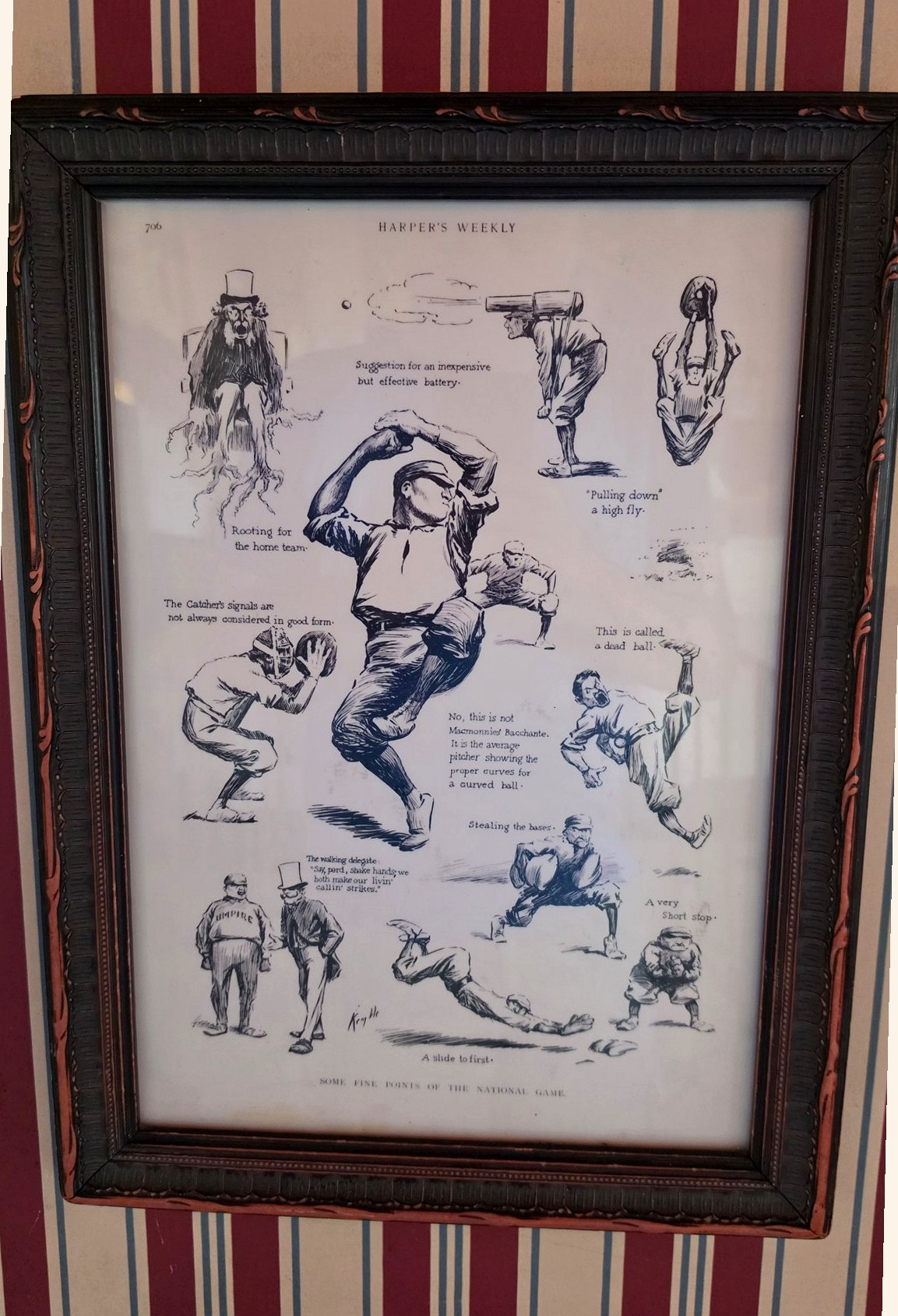
Order a hot dog at Casey’s Corner, on Main Street, U.S.A., and before you take a bite, look at the wall. Between the pennants and the photographs hangs a framed sheet of newsprint, dense with drawings: a pitcher frozen mid-windup at the center, and around him a swarm of smaller scenes, each carrying its own punchline. It is page 706 of Harper’s Weekly, the issue of July 28, 1900, and the title along the bottom reads Some Fine Points of the National Game. It may be the funniest page of baseball ever printed, and it is hiding in a hot-dog line.
In 1900, this was how America watched the game. Harper’s Weekly — the great illustrated newspaper of the nineteenth century, “a journal of civilization” by its own billing — reached its readers through drawings, and the cameras of the day were far too slow to freeze a swing or a slide. So the national game arrived by ink. The hand holding the pen signed his name at the foot of the page: Kemble. Edward W. Kemble was the illustrator Mark Twain had personally picked, fifteen years earlier, to draw the first edition of Adventures of Huckleberry Finn. Here he is doing sports gags, and every one of them still lands.
Start at the top left. A fan in a top hat sits rooted to his seat, his legs literally growing into the ground: Rooting for the home team, the slang made flesh. Beside him, a pitcher does his work through a small cannon — Suggestion for an inexpensive but effective battery. A fielder hangs in the air ‘Pulling down’ a high fly, another ends up entirely upside down, a catcher gives signals that are not always considered in good form, and a batter crumples under the driest caption on the page: This is called a dead ball. Low down, a crouching runner is Stealing the bases, the smallest player in the drawing, barely knee-high, is A very short stop, and an umpire shakes hands with a union man in a top hat: The walking delegate: “Say, pard, shake hands; we both make our livin’ callin’ strikes.” It is a labor joke and a baseball joke in the same breath — a walking delegate was a union official, and calling strikes was his line of work too.
The big windup at the center gets the most literary joke of all: No, this is not Macmonnies’ Bacchante. It is the average pitcher showing the proper curves for a curved ball. MacMonnies’ Bacchante — a bronze of a dancing woman with grapes in hand — was the era’s most argued-about statue, a few years past scandalizing proper Boston, and Kemble’s readers were expected to get it instantly: the pitcher’s pose, arm high and body twisted, was high art whether he knew it or not. Eleven years later, Kemble filled another Harper’s page with baseball caricatures — by then drawing real stars by name: Honus Wagner, Christy Mathewson, Ty Cobb, Johnny Evers.
Why does this page hang in a Disney restaurant? Because Casey’s Corner is a shrine to baseball’s paper age. The spot had served Main Street since the park opened in 1971, as the Refreshment Corner; in 1995 it took the name it carries now, from Casey at the Bat, Ernest Lawrence Thayer’s 1888 poem about the mighty Casey striking out with the game on the line — a poem Disney itself had animated back in 1946. The restaurant keeps the faith down to the details: red pinstripes on the walls, a concession-stand counter, and the score as it stood when Casey stepped up, Mudville trailing 4 to 2. Poem and cartoon stand twelve years apart, products of the same moment, when baseball was becoming America’s shared story and print was the only screen it had.
That kinship is why the page earns its place in our Vintage Design series — and why it feels close to home for a drawing studio. Kemble’s page is one ink, no color, built entirely on character and timing: seconds to read, a century to forget. It is the same economy we chase in our own retro cartoon work; the Daydreamer tee in our Print Shop is a retro schoolroom cartoon drawn to be read across a room, the way Kemble’s pitcher reads across a restaurant. The tools changed. The joke didn’t. A drawing that still gets the laugh 126 years later, in a room full of people who have never heard of its artist, is not decoration. It is design that did its job.
The cartoon does not hang alone. In the frame beside it, three five-cent covers tell the story of Frank Merriwell, the hero a generation of boys bought one nickel at a time — the second wall of Casey’s Corner, and the next stop in this series.
Featured image: “Some Fine Points of the National Game,” Harper’s Weekly, July 28, 1900, drawn by E. W. Kemble — photographed at Casey’s Corner, Magic Kingdom.