

Vintage Design
Merriwell vs. Merriwell: The Five-Cent Hero on the Wall at Casey’s Corner
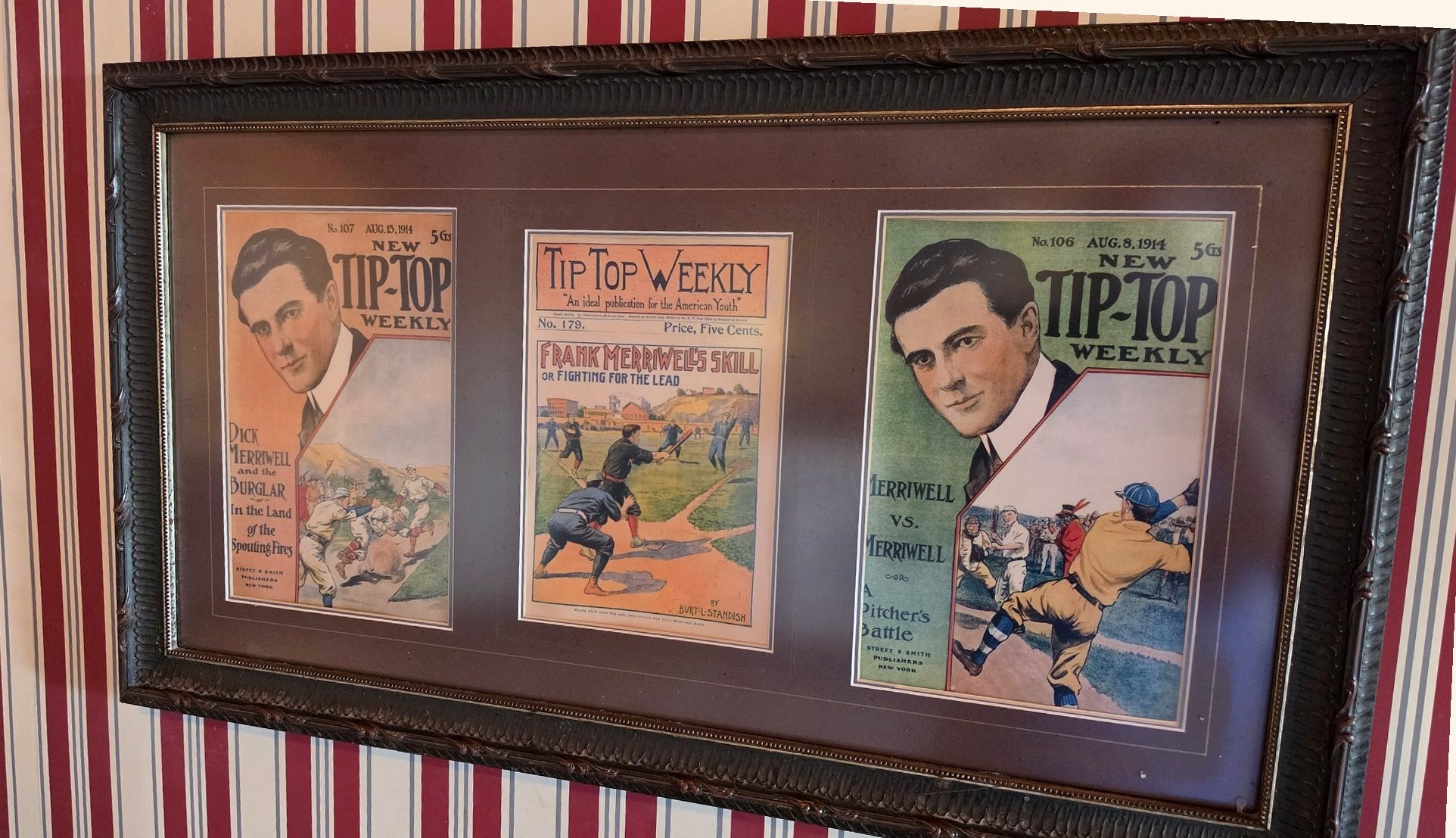
A few feet from the Harper’s Weekly cartoon hangs a second frame at Casey’s Corner, and this one holds three magazine covers in a row. A boy who spent five cents on the middle cover in 1899 could have bought the two beside it as a grown man in 1914 — and met the same hero on all three. The covers belong to Tip Top Weekly, one of the best-selling of the five-cent “nickel weeklies,” and the hero is Frank Merriwell: the original American sports hero, a generation before the real ones had agents.
Merriwell was created by Gilbert Patten, a writer for the New York publishers Street & Smith, who signed himself Burt L. Standish. He first appeared on April 18, 1896, in the very first issue of Tip Top Weekly — Frank Merriwell; or, First Days at Fardale — a schoolboy at the fictional Fardale Academy who went on to Yale and played every sport there was, baseball first among equals. He played fair, he kept his head, and in the ninth inning he delivered; Patten produced a new Merriwell novel practically every week for years, hundreds of stories in all, and the character outlived the format, going on to radio dramas and a newspaper comic strip. For boys who would never see a big-league park, Merriwell was not a story about sports. He was sports.
Now read the frame. In the center hangs the oldest cover: Tip Top Weekly No. 179, dated September 16, 1899 — Frank Merriwell’s Skill; or, Fighting for the Lead, a batter driving the ball while the field scrambles. Above the title sits the promise Street & Smith carried in the masthead: “An ideal publication for the American Youth.” That one line did heavy commercial work — it told parents the nickel weekly was good for their sons — while the price beside it, five cents, told the sons the rest.
The two flanking covers come from the magazine’s second life. The original Tip Top Weekly ended in 1912, and Street & Smith relaunched it as the New Tip Top Weekly, renumbered from No. 1, mixing reprints with a new generation: Frank’s younger half-brother Dick, who had taken over the Fardale stories years before, and Frank’s son, Frank Jr. On the left, No. 107, August 15, 1914: Dick Merriwell and the Burglar; or, In the Land of the Spouting Fires — a burglar adventure in geyser country that still gets a baseball cover, a tag play exploding in dust, because baseball was what sold the paper. (The New York Public Library’s catalog, incidentally, still describes this entire series starting from this very issue.) On the right, one week earlier, No. 106: Merriwell vs. Merriwell; or, A Pitcher’s Battle — one Merriwell pitching against another, the dream match as cover bait. Both 1914 covers use the same device: the hero’s handsome portrait floating over an action scene. Character first, story second. That is not primitive design; that is branding before the word existed.
The dates carry one last charge. Those two covers are dated August 8 and August 15, 1914. Four weeks earlier, on July 11, a nineteen-year-old pitcher named Babe Ruth had won his first major-league game for Boston. Fiction’s perfect ballplayer was still commanding the newsstand in the very summer the real one’s legend began — and the décor at Casey’s Corner, knowingly or not, puts them on the same wall.
That is why these covers belong in our Vintage Design series, next to the Harper’s page they hang beside. The Merriwell covers were graphics doing a job at full stretch: one face, one title in fat display type, five cents of promise, sold to a boy with a nickel and thirty seconds to choose. Character-first sports graphics are the direct ancestors of what fills our Print Shop today — our Game Day Rocks tee runs on the same newsstand equation as Standish’s covers: you know the hero before you read a word. A face strong enough to sell a story every week for twenty years, across two centuries of readers, is not nostalgia. It is a standard — and Casey’s Corner, hot dogs and all, keeps it framed.
Featured image: three covers — Tip Top Weekly No. 179 (1899) between New Tip Top Weekly Nos. 107 and 106 (1914) — photographed at Casey’s Corner, Magic Kingdom.