

Vintage Design
The Dinosaur Who Took Orders: How Gertie Taught Cartoons to Have a Personality
Editorial
In February 1914, at the Palace Theatre in Chicago, a cartoonist walked onstage, stood next to a blank screen — and scolded a dinosaur. She had just thrown a mammoth into a lake. She hung her head. Her shoulders shook. A drawing, made of ink on paper, was crying because she had been told off — and the audience was not laughing at a trick. They were watching a personality. Her name was Gertie, and almost everything animation would become starts with the question her act forced for the first time: what if a drawing could behave?
A bet in front of a skeleton
Winsor McCay was already famous — the artist behind the dreamlike Sunday strip Little Nemo in Slumberland and a star of the vaudeville circuit, where he drew at lightning speed in front of live crowds. He had put drawings in motion before, with Little Nemo in 1911 and How a Mosquito Operates in 1912. But those were demonstrations. The dinosaur began, by the story McCay later filmed, in front of a Brontosaurus skeleton at the American Museum of Natural History, where he bet fellow cartoonist George McManus a dinner that he could bring a dinosaur back to life with nothing but drawings. It was a stage magician’s wager: the trick was impossible, which is exactly why it was worth doing. What nobody at that dinner could have guessed was how much invisible machinery the “trick” would require.
Ten thousand drawings, and one boy tracing the world
By McCay’s own account, Gertie took some 10,000 drawings. He drew every one of Gertie’s herself, inked on rice paper — and because animation had no production system yet, the backgrounds had to be redrawn on every single sheet too. That mind-numbing job went to his young neighbor, John A. Fitzsimmons, who carefully retraced the same rocks, trees and lake thousands of times so the world would hold still while its star moved. A contemporary account marveled that it took fifteen drawings just for Gertie to lift one foot. Breathing — the slow rise and fall that makes her feel alive between the gags — took dozens more, in and out. Buried in that labor are the inventions the whole industry still runs on: key drawings that define a movement, registration marks that keep thousands of sheets from jittering, tracing paper, a hand-cranked viewer to test motion, and animation loops that reuse drawings instead of redrawing them. McCay never patented any of it. He was not building a studio. He was building one dinosaur.
The secret was not the dinosaur. It was the disobedience
Earlier cartoons moved. Gertie acted. In the act, McCay stood beside the screen like a trainer and gave orders, and the film was timed so the illusion held: Gertie emerged from a cave, bowed, ate, danced, tossed a boulder, teased a mammoth until it ended up in the lake — and when McCay scolded her, she cried. When she was pleased with herself, you could tell. The finale broke the wall between stage and screen entirely: McCay appeared to step into the picture, climbed onto her back, and Gertie carried her creator away. That is the design lesson hiding inside the comedy. Gertie’s silhouette — the long neck, the small head, the enormous patience of her body — is simple enough to read at a glance. But what made her immortal is not the silhouette. It is the consistency: shy, vain, mischievous, eager to please, in every scene, in the same order of feelings. A character is not a shape. A character is a set of behaviors an audience can predict — and be surprised by, on purpose.
How the act escaped the stage
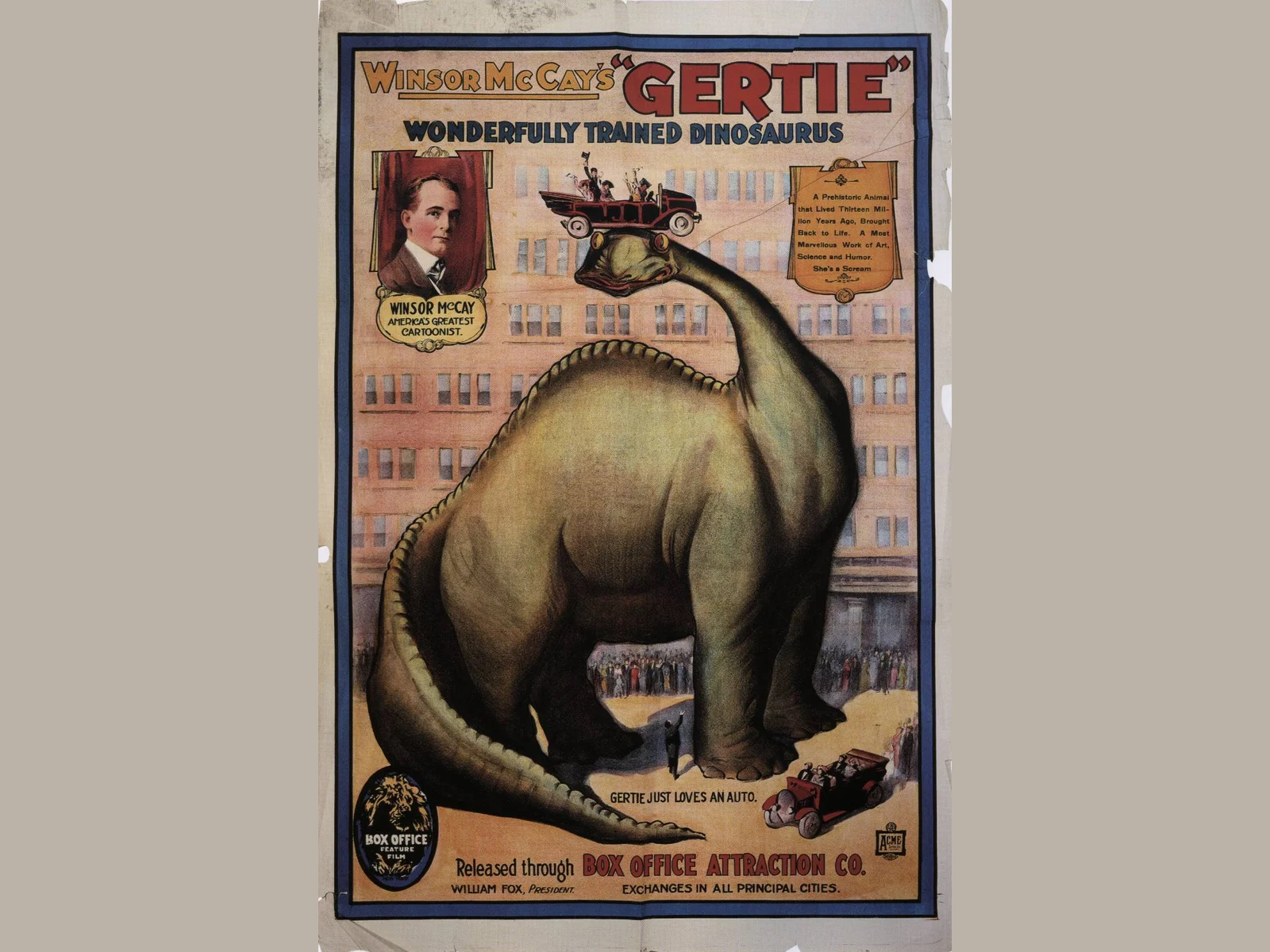
Gertie might have stayed a vaudeville memory. McCay’s employer, newspaper magnate William Randolph Hearst, curtailed his stage appearances, so McCay rebuilt the act as a film anyone could show: he added a live-action prologue — the museum, the bet, the mountains of drawings, an assistant dramatically dropping them — and released it through William Fox’s Box Office Attractions Company, the same outfit whose poster, shown above, sold her as a “wonderfully trained dinosaurus” who “just loves an auto.” A sequel, Gertie on Tour, was abandoned after about a minute of footage. It did not matter. The original kept travelling without him, and in 1991 the Library of Congress selected Gertie the Dinosaur for the National Film Registry — the trained dinosaur, preserved forever, still taking orders from a man who has been gone for ninety years.
What a mascot designer can still steal from Gertie
Every mascot drawn today — including the letter-mascots and storybook faces in our own studio’s work — is graded, knowingly or not, by Gertie’s standard. Draw the behavior before the costume: if your character cannot sulk, celebrate and get caught misbehaving, it is a logo, not a character. Keep the silhouette blunt enough to read across a room, then spend your detail budget on expression, the way McCay spent thousands of drawings on a dinosaur’s feelings and let a neighbor trace the trees. And protect the consistency: Gertie never breaks character, which is why one scolding could make a theatre full of adults feel sorry for ink. Fourteen years after Gertie, another cartoonist would lose a rabbit to a contract and answer with a mouse — that story is in our Design Masters archive too, and so is the desk where characters were born. Read the whole line in the Design Masters archive — it starts, as animation itself did, with a dinosaur who took orders, and disobeyed beautifully.
Featured image: the original 1914 theatrical poster for Winsor McCay’s “Gertie,” released through the Box Office Attractions Co. — public domain, via Wikimedia Commons.