

Vintage Design
The Posters America Almost Lost: The WPA National Park Series
Between 1936 and 1943, the United States government ran one of the largest art studios in its history — and then threw most of the work away.
The studio was the poster division of the Federal Art Project, part of the Works Progress Administration, the New Deal program that put unemployed Americans to work during the Great Depression. Its artists designed posters for everything the government wanted to say: go to the library, see a play, mind your health, visit a national park. The Library of Congress preserves more than 900 of the designs today, out of roughly 2,000 known — and for the national parks, the numbers are far smaller, and the story far stranger.
In 1938, the National Park Service’s Western Museum Laboratories in Berkeley, California, began screen-printing a series of park posters. Screen printing is a beautiful, unforgiving technique: one flat color at a time, one screen per color, no gradients, no second chances. It forced a style — bold silhouettes, a handful of colors, lettering you could read across a train station — that still defines what “national park poster” means today.
Only fourteen parks ever got a poster. Each was printed in tiny runs, perhaps fifty to a hundred copies, and when the war came the program ended and the posters became surplus paper. They were pinned up, worn out, and discarded. For thirty years, the series effectively didn’t exist.
Then, in 1973, a Grand Teton National Park ranger named Doug Leen noticed one of the original posters in a pile of material headed for disposal — and rescued it. That rescue became a life’s work. Leen spent decades hunting the surviving originals through park archives and attics, and in the early 1990s thirteen black-and-white negatives of the designs surfaced inside the National Park Service’s own files. Today, twelve of the fourteen designs are accounted for in public collections. One — Yosemite — turned up at auction and vanished into private hands. Two, for Wind Cave and Great Smoky Mountains, have never been found at all.
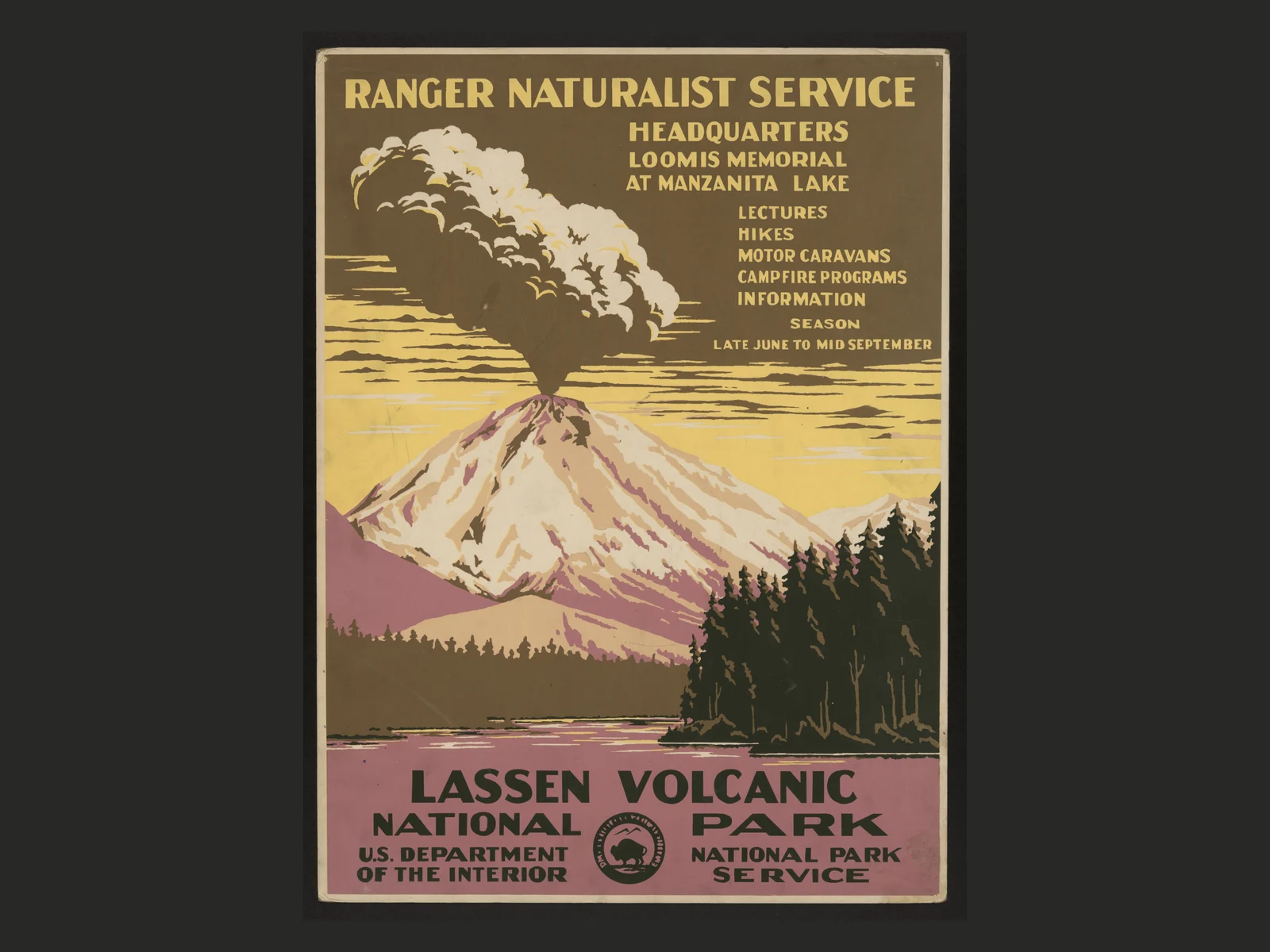
The poster at the top of this page is one of the survivors: Lassen Volcanic National Park, designed by Chester Don Powell around 1938 — an erupting peak, a lake, a stand of pines, and an invitation to the Ranger Naturalist Service’s lectures, hikes and campfire programs, season late June to mid-September. Four or five flat colors. Not a wasted line in it.
Because the posters were drawn by federal artists on a federal payroll, they belong to everyone — the Library of Congress makes them freely available, and the style has been reprinted, imitated and loved back into American visual culture. We study them in this studio the way musicians study old records. If you want to know how much a handful of flat colors can do, a WPA park poster will teach you in one look — and it’s the same discipline we reach for when a design has to read from across the street, on a chest instead of a wall.
Featured poster: Lassen Volcanic National Park, Works Progress Administration, c. 1938. Library of Congress — public domain.